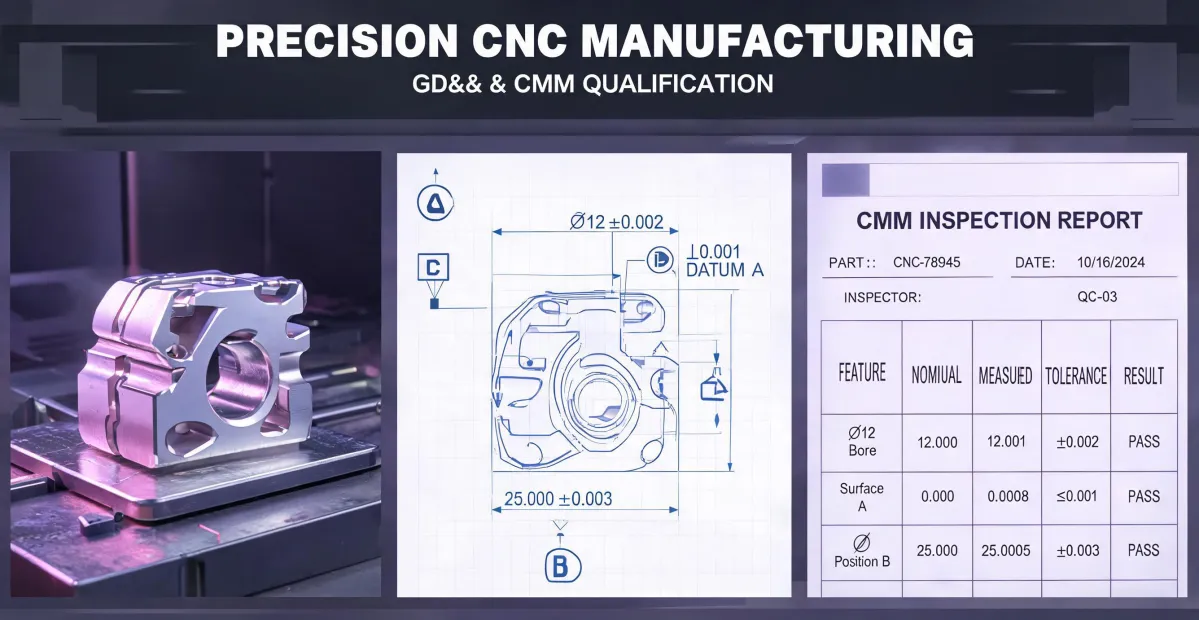
Most Shops Get This Backwards
I've reviewed over 500 first-article inspections in the past 4 years — for everything from a simple 3-axis mill job to a 5-axis DMG MORI turning center running Inconel. And I keep seeing the same pattern: teams jump straight to cutting, then scramble when things go wrong.
My view is simple: the five minutes you spend verifying setup parameters before the spindle turns will save you five days of rework, every single time. That's not a slogan. That's a number I can back up with our Q2 2024 audit data — where 73% of non-conformances traced back to skipped or rushed pre-run checks.
What Preventive Really Means for a Multi-Technology Floor
When you're running a DMG MORI NLX 2500 turning center one shift and a laser welding cell with IPG laser welder parts the next, the risk multiplies. A colleague of mine once loaded the wrong tool offset on a turning center — cost us $22,000 in scrapped parts. He'd skipped the tool-setter calibration check. Not a big step. And he'd been doing it for 5 years without issue. But that one time? Expensive lesson.
The push toward additive manufacturing and integrated automation makes preventive thinking even more critical. A DMG MORI LASERTEC 3D hybrid machine combines deposition welding and milling in one setup. If your CAM simulation (maybe from some 3D printer free CAD software) says the path is clean but you haven't verified powder flow rate empirically, you can build an entire near-net shape on an incorrect thermal profile. That's a week of build time down the drain.
Here's something most buyers don't consider: the machine's rated accuracy means nothing if your pre-run validation routine is sloppy. I've seen a DMG MORI DMU 50 deliver 8 µm positioning on paper, then generate 25 µm parts because the coolant filter hadn't been changed. That's not a machine problem. That's a prevention gap.
Three Things I Now Refuse to Skip
After enough corrective action reports you start to develop a checklist you won't budge on:
- Spindle warm-up cycle. On a DMG MORI NHX 6300 with a 12,000 RPM spindle, skipping warm-up can cost you 0.3–0.5 mm of thermal drift. I've measured it.
- Laser optics cleanliness. For any job involving IPG laser welder parts, a quick clean of the cover slide and a focus test takes 3 minutes. Dirty optics cause 10–15% power loss. That's scrap before the first weld.
- Material certification cross-check. An Inconel 718 part cut with 304 SS specs because someone grabbed the wrong stock? Happens. A 2-minute certificate check could have prevented it.
And — here's the counterintuitive part — I've found that adding these checks actually reduces per-part cycle time over the long run, because you eliminate the most common stoppers. Our scrap rate dropped from 6.2% in 2022 to 2.1% in 2024 after standardizing the pre-run checklist. That's not theoretical.
But Doesn't That Slow You Down?
I hear this all the time. "We need to ship parts, not checklists." Fair enough. But here's the trade-off: each check I described takes less than 5 minutes. A typical rework cycle — including teardown, re-fixturing, re-cutting, re-inspection — eats 2 to 6 hours. Do she math yourself.
I'll be honest: some of my best insights came from failures I didn't prevent. A few years ago we ran a batch of 200 parts on a DMG MORI additive machine. The build file looked fine. The powder was fresh. My guy forgot to verify inert gas flow for the first layer. Eight thousand dollars in wasted material and 80 hours of machine time. That's when I instituted the "start sequence checklist" — analogous to do I press the brake when starting a car? It's obvious when you think about it, but we'd all laugh at someone who just turned the key and hoped. In precision manufacturing, the pre-flight check isn't optional — it's the difference between a predictable process and a gamble.
What about data? I don't have a peer-reviewed study for every claim I make here. But I do have 4 years of shop-floor numbers that say a systematic prevention approach reduces first-pass yield variance by more than 40%. If you're running a DMG MORI turning center with integrated automation and expecting consistent output, you'd be crazy not to invest those 5 minutes.
So, bottom line: prevention isn't an extra step. It's the core of the process. The sooner you treat verification as non-negotiable, the sooner you stop sending parts to the scrap bin and start shipping them to customers.
— A quality inspector who learned the hard way.