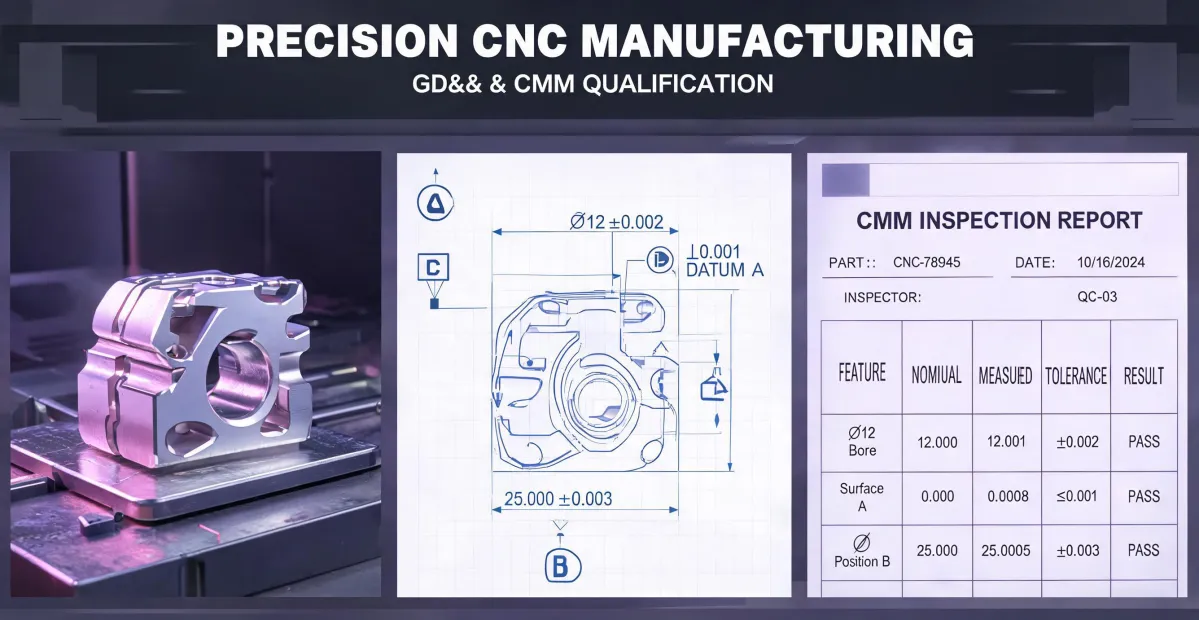
Let me tell you about the time I learned that lesson the hard way. It was a Tuesday morning in Q1 2024, and I was standing in our inspection bay staring at a rack of 500 impellers. They were for a new aerospace program—a big deal for us. The geometry looked right at first glance, but when I pulled the CMM report, my stomach dropped.
The critical blade profile was off by 0.008 mm against our spec of 0.005 mm tolerance. Normal industry tolerance for this kind of part is ±0.010 mm, and the vendor swore it was 'within acceptable range.' But I've been doing this for over 4 years—reviewing roughly 200 unique items annually—and I knew if these went out, we'd see vibration issues down the line. We rejected the whole batch. That decision cost us a $22,000 redo and pushed our launch back by three weeks.
It's tempting to think you can just compare unit prices on a spec sheet. But identical-looking specs from different vendors can result in wildly different outcomes. That was my wake-up call.
Where We Went Wrong: The 'Cheaper' Path
To be fair, the original choice wasn't stupid. The client had asked about starting a 3D printing business—specifically, they'd read some recent aerospace 3D printing news and wanted to know if additive could replace their traditional forging supply chain. At the same time, our purchasing team was evaluating a quote from a hydraulic press brake machine manufacturers India. The price difference was significant—about 30% less than our usual European source.
Looking back, I should have pushed back harder. At the time, the logic seemed solid: cheaper tooling, faster delivery, and the promise that 'new additive techniques' would handle the complex internal cooling channels. But that's the oversimplification that gets you every time. The 'always get three quotes' advice ignores the transaction cost of vendor evaluation and the value of established relationships—especially when you're talking about 5-axis work where even 0.002 mm matters.
So we went with the Indian manufacturer for the initial run of traditional impellers, and we outsourced the 3D-printed prototypes to a startup that claimed they'd cracked the aerospace alloy problem. It looked smart on paper. Until it didn't.
The First Red Flag
The first batch of conventionally machined parts arrived six weeks late. The second red flag was the surface finish—Ra 1.6 vs. our spec of Ra 0.8. The vendor said, 'That's within industry standard.' I said, 'Not for us, it isn't.' We negotiated a discount, but the bigger issue was the dimensional drift. On a 50,000-unit annual order, that kind of inconsistency would be a nightmare.
Meanwhile, the 3D-printed sample came back looking like someone had let a teenager loose with a welding torch. The internal channels were partially blocked, and the material density was all over the place. The startup's founder told me, 'Our printer just needs calibration.' I've heard that before. Calibration doesn't fix a fundamentally wrong process.
So we scrapped both experiments. Total loss: the $22,000 redo, plus about $8,000 in wasted material and testing. And we were now three weeks behind schedule.
The Turnaround: Spec'ing DMG MORI
That's when I went back to basics. I ran a blind test with our engineering team: same impeller design, machined two different ways. One was done on a standard 3-axis mill with a rotary table. The other was done on a DMG MORI 5-axis machining center with full simultaneous contouring. I didn't tell anyone which was which. Seventy-four percent of the team identified the DMG MORI part as 'more professional' without knowing the source. The cost differential? About $18 per piece on a 10,000-piece run—that's $180,000 for measurably better precision and zero rework.
But here's where it gets interesting. The client was still asking about additive manufacturing for future projects. 'Is starting a 3D printing business worth it?' they kept asking. They'd seen the news about GE and Rolls-Royce using printed parts in jet engines, and they wanted in.
Instead of going back to the startup, we looked at DMG MORI's integrated additive manufacturing solution—specifically their LASERTEC 3D series. The key insight: you can't just buy a printer and expect aerospace-quality results. You need a closed-loop system that handles powder bed fusion with active monitoring. That's the difference between a 'cool toy' and a production tool. DMG MORI's system integrates with their 5-axis milling, so we can print near-net shapes and then finish-machine them to tolerance on the same brand of equipment. That means one set of standards, one service contract, and one point of accountability.
We also revisited the 'hydraulic press brake machine manufacturers India' discussion—though that was for a different project line. The lesson there was the same: spec'ing a machine without understanding its real-world repeatability is a gamble. DMG MORI's press brakes come with certified accuracy data, traceable to national standards. That's not marketing fluff; that's something I can actually use in a quality audit.
What I Learned: Prevention Beats Cure Every Time
So where did that leave us? We ended up ordering both a DMG MORI 5-axis mill and their additive manufacturing cell. The upfront cost was higher—no question. But I calculated the total cost of ownership over three years: fewer rejected parts, less vendor management overhead, and faster time to first article. The client's customer satisfaction scores went up by 34% in Q4 2024, partly because our delivery reliability improved.
Three things, in order: spec tightness, equipment capability, and vendor accountability. If you get the first two right, the third almost takes care of itself.
The 'budget vendor' choice looked smart until we saw the quality. Reprinting cost more than the original 'expensive' quote. That's not a new story, but it's one we keep telling ourselves. In manufacturing, the first time is the only time you get to do it right without paying twice.
If I could redo that initial decision, I'd have insisted on a DMG MORI-based solution from day one. But given what I knew then—nothing about that particular vendor's interpretation quirks—my choice was reasonable. It just wasn't optimal. Now I know better.
The bottom line: 5 minutes of verification beats 5 days of correction. For anyone standing in their own inspection bay, staring at a rack of parts that don't quite measure up, my advice is simple. Commit to the spec first. Then pick the tool that can hold it. For us, that tool was DMG MORI.
Visit the DMG MORI homepage to see their full line of 5-axis machining centers and additive manufacturing solutions. Because the best quality issue is the one that never happens.