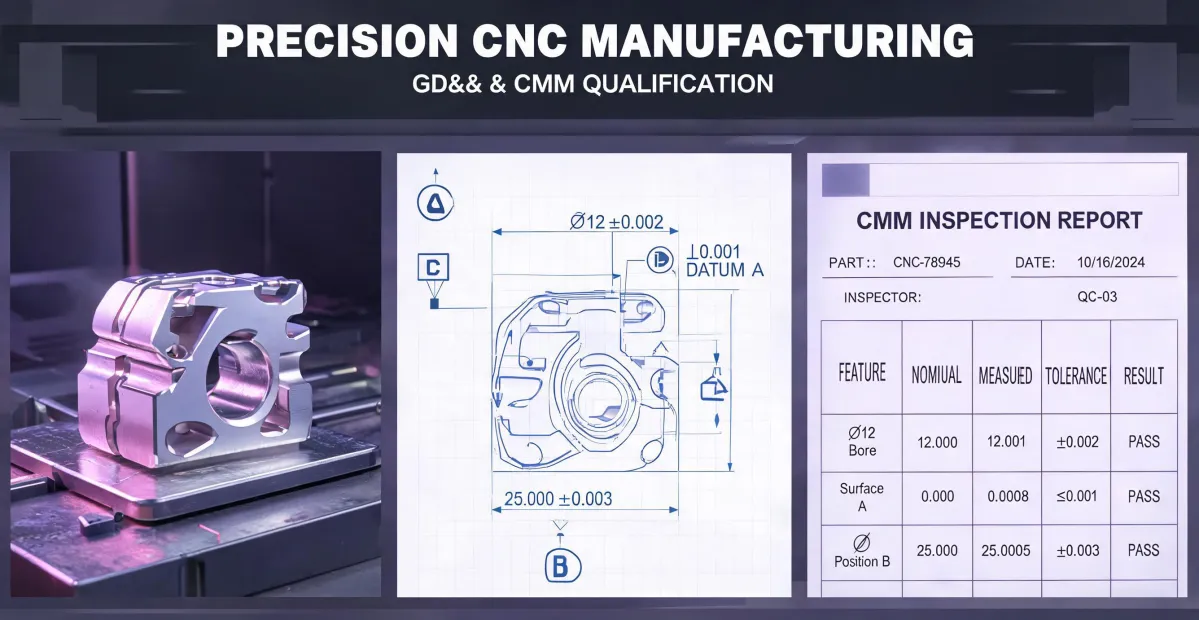
I'm a quality and compliance manager at a precision machining supplier. I review first-article parts and production lots before they ship—roughly 1,200 line items a year. In Q1 2025 I rejected 7% of first deliveries. The causes weren't dramatic: tolerance drift, poor edge condition, and missing process data.
When buyers ask whether they should use a DMG MORI CNC lathe, a machining center, or a laser cutter, I don't answer with a slogan. It depends on the drawing. But I can tell you how I compare them, what I inspect, and why a fiber laser is not a universal cutter.
A process you cannot measure is a process you cannot approve.
How I Set Up the Comparison
Laser cutting and CNC machining overlap more than people think. You can make simple brackets, plates, and signs with either if you include enough secondary work. So I compare them on three dimensions: geometric features, material response, and scheduling certainty. Those three dimensions decide whether the part reaches my desk as a conforming part or as a problem.
Dimension 1: Geometric Features and Tolerance
Laser cutting is a flat-pattern process. A focused beam melts or vaporizes material along a line, which makes it excellent for cutting profiles from sheet metal. Laser cutting metal signs, for example, is a proven application: moderate tolerances, quick changeovers, and low fixture costs.
What a laser cannot do is create a machined surface. It can't cut a square-bottomed slot, tap a threaded hole, bore a true diameter, or hold flatness to the level a milling cutter can. That's where CNC machining wins. A DMG MORI CNC lathe with live tooling can turn, mill, drill, and tap in one setup. A machining center can create datums, pockets, and accurate hole patterns on prismatic parts.
Here's something I check before any tight-tolerance run: fluid temperature. DMG MORI CNC cutting lubrication temperature isn't printed on most quotes, but it should be. The coolant does more than lubricate; it carries heat away from the cut. If its temperature changes during the day, the machine's thermal state changes with it. On a 40 mm shaft, I've measured a few microns of diameter difference between morning and afternoon. So when someone tells me lubrication temperature doesn't matter, I assume they haven't measured it.
Let me rephrase the conclusion: a laser is not an alternative when the part has threads, bores, or tight true positions. It's a pre-process at best.
Dimension 2: Material Behavior and the Wood Question
Material response is the second comparison. Fiber lasers work well on steel, stainless steel, and aluminum because their wavelength around 1.06 µm is absorbed efficiently by metal. That's why laser cutting metal signs is common. But the cut edge is still a thermal edge. The heat-affected zone (the area where the beam changes the material's microstructure) can be narrow and acceptable for decorative work, or it can be unacceptable for a fatigue-loaded component.
CNC milling automotive technology is not one operation. It includes facing, contouring, pocketing, drilling, and thread milling, each with specific tool paths and feed rates. When a transmission housing needs a stable sealing surface, I don't want a molten edge nearby. I want a cutter producing chips under controlled conditions.
Last year I rejected a batch of laser-cut aluminum plates even though the outside dimensions were in spec. The problem was a 6.00 mm slot: the laser produced a taper, and the back side of the slot measured 6.17 mm. For a decorative sign, no one would care. For a sensor retainer, the assembly felt loose. That's the difference between cutting a profile and making a part.
Now for the question that appears in search logs: can u use a fiber laser to cut wood? The short answer is not well. Don't base a production process on it.
Fiber lasers are designed for metal. Wood does not absorb the 1.06 µm wavelength the same way, so instead of a clean cut you get scorching, smoke, and inconsistent depth. A CO2 laser works better on wood because the longer wavelength is absorbed by organic materials. But if your main job is laser cutting metal signs, don't expect one fiber machine to double as a wood cutter. I should add that someone may get acceptable wood engraving with the right settings, but clean cutting is a different challenge.
Dimension 3: Cost, Lead Time, and the Certainty Premium
Cost is usually the next question. It's tempting to compare a shop's hourly rate or price per meter of cut. That comparison misses setup, inspection, rework, and schedule risk. You're not buying cutting time; you're buying a completed, conforming part.
Here is a counterintuitive result I've confirmed many times: a simple flat bracket cut by laser may take 20 seconds. If the same bracket needs two tapped holes and a machined datum face, the laser cut is not the final step. The blank has to move to a CNC machine, get located, clamped, drilled, tapped, and deburred. Compare that to a CNC machining center that completes the bracket in one setup. The machining cycle might take four minutes, but the part comes off complete. The laser route has two operations, two queues, and two chances for error. For small-to-medium batches, one complete setup often beats the faster-looking laser process.
Schedule risk is the third hidden cost. I'm not saying always pick the most expensive process. I'm saying you should place a value on certainty. In March 2024, I approved a $400 rush charge on a stainless sign order because the client's opening date couldn't move. The money didn't buy speed alone. It bought a guaranteed delivery window. If a late delivery costs more than the rush fee, the rush fee is a rational purchase.
So How Would I Choose?
If the drawing is flat sheet metal, the tolerances are moderate, and the edge won't be a sealing or fatigue surface, choose laser cutting. It's flexible, fast, and cost-effective for signs and low-to-medium volume profiles.
If the part has machined features, cylindrical surfaces, tight bores, or threaded holes, choose CNC machining. A modern DMG MORI CNC lathe or machining center can reduce operations by keeping the part in one setup, and the process data is easier to control. For automotive and aerospace work, I ask for cutting lubrication temperature records, tool compensation data, and first-article inspection results. Those records show whether the supplier controls the process or just hopes it turns out okay.
And the wood question again? No. If someone asks whether a fiber laser can cut wood, the answer is still the same: not for clean production. Use a CO2 laser for thin wood, or a CNC router if you need an edge that looks intentional. A fiber laser is a metal tool. Respecting that boundary is cheaper than testing it.