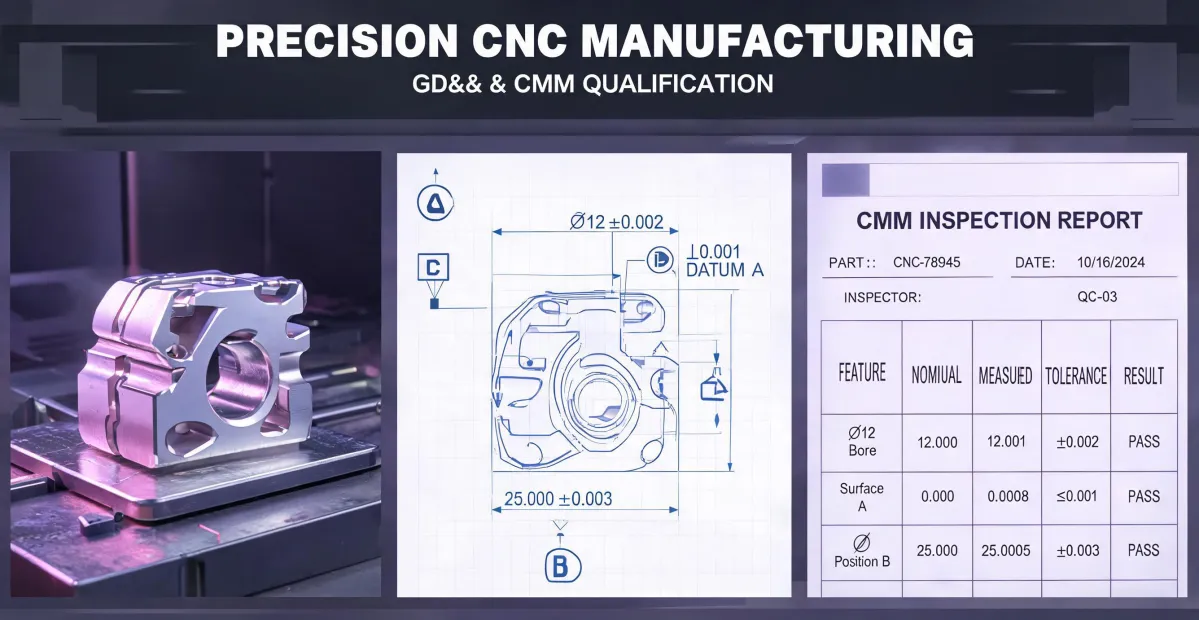
If you're pricing a DMG MORI machining job and your spreadsheet only has the unit price, stop. The first question shouldn't be "which quote is lower?" It should be "what does the final invoice include?" I've managed machining orders for nine years, and I've personally made—and documented—four significant mistakes totaling roughly $18,000 in wasted budget. The painful part? Three of those mistakes had nothing to do with the machine. They were quote-comparison errors.
Let me rephrase that: the machine matters, but not the way most buyers think.
The Cheaper Hourly Rate Was Not Cheaper
It's tempting to think you can just compare machining quotes by hourly rate or by machine brand. But identical specs from different vendors can produce wildly different outcomes.
Last spring, I quoted an aluminum alloy CNC machining order—18 pieces, 6061-T6, with a tight bore tolerance and a 63 micro-inch surface finish. One local vendor quoted $38 per hour. A second vendor, with a reputation for documentation, quoted $46 per hour. I went back and forth between the two for two weeks. The first vendor had the lower rate; the second vendor had the better first-article inspection process. I chose the lower rate because the project budget was already tight.
The first vendor's final invoice was $2,340. The second vendor's quote was $2,190. What happened? The first vendor charged separately for setup, deburring, material certification, and the inspection report. The second vendor included those in the hourly rate. The "$38" rate cost us $150 more.
Put another way: an hourly rate tells you about the meter, not the bill.
A DMG MORI CNC machine could hold that bore tolerance without breaking a sweat. The machine wasn't the problem. The quote structure was.
The DMG MORI CNC Is a Tool, Not a Guarantee
I used to think buying time on a DMG MORI CNC automatically meant tighter tolerances. Then I watched a five-axis machining center produce out-of-tolerance parts for three days while the operator trusted a worn toolholder. The machine was fine. The process was not.
That's why the "dmg-mori" name can be dangerous in a quote. It creates confidence that should be earned by measurements, not by the badge on the control panel. I'm not saying the brand doesn't matter—it does, especially for rigidity and thermal stability. But "DMG MORI machining" doesn't mean much if the setup, tooling, and inspection plan aren't defined.
For alloy CNC machining work, the material also matters more than the spindle speed. 6061-T6 behaves differently than 7075-T6, and both behave differently than titanium. A shop that knows your alloy and can prove it with a test report is worth more than a shop with a shiny machine.
What I Learned from a 'Standard' Surface Finish
In September 2022, I approved a 50-piece alloy CNC machining order with a "standard" surface finish. I assumed "standard" meant the same Ra number we'd used on previous orders. It didn't. The parts came off the machine at 80 micro-inch instead of the 63 micro-inch on the print. We caught it during first-article inspection (thankfully, because we'd paid for the inspection). But 47 pieces still had to be reworked.
That mistake cost $1,150 in redo plus a one-week delay. The real lesson: "standard" is not a specification. If it's not written on the drawing, it's not a requirement—it's a hope.
People think expensive vendors deliver better quality. Actually, vendors who can deliver quality charge more. The causation runs the other way. You're not paying for the machine; you're paying for proof that the part works.
How I Calculate Total Cost Before Approving Any Quote
The biggest change in my process happened after that September 2022 order. Now I calculate total cost, not unit price, before comparing vendors. Here's the short list I keep pinned above my desk:
- Base price — what the quote actually says for the machined part.
- Setup and tooling — separate line item, or baked into the rate? Ask directly.
- First-article inspection — who pays for the CMM report and what does it include?
- Logistics and packaging — special protective packaging can add a surprising amount.
- Rework and delay risk — I add a conservative 10% buffer for tight tolerances or unfamiliar materials (like 17-4 PH stainless or Inconel).
After those five numbers, I compare. The $500 quote that becomes $800 after shipping, setup, and a revision fee is not cheaper than the $650 all-inclusive quote. That's the whole thesis.
I've also paid an "expedited" fee that added 50% to the job (which, honestly, felt excessive) and still got the parts two days late. Now I ask about turnaround commitments in writing.
What I Ask Before Sending a Drawing
After the 2022 mistake, I built a pre-order checklist. It's not fancy, but it catches more than you'd think:
- Are the critical dimensions on the drawing? No "as per standard practice."
- Is the surface finish exact? No "standard" without an Ra value.
- Is the material grade and condition specified? 6061-T6 is not 6061-0.
- Is the inspection method named? CMM, bore gauge, or go/no-go?
- Who owns the risk if the first article fails?
That last one matters more than most people think. If the supplier owns the risk, they'll check before shipping. If you own the risk, you'd better have your own inspection plan.
Put Claims in Writing
Per FTC guidelines (ftc.gov), advertising claims must be truthful and not misleading. That applies to machine-tool marketing too. If a supplier promises "zero defects" or "guaranteed repeatability," ask for the data behind the claim. A CMM report from the last three similar jobs is a reasonable starting point. If they can't show one, that's not a promise—it's a pitch.
I should add that this isn't about distrusting suppliers. It's about making the requirement clear enough for both sides to verify. The shop that documents everything is usually the shop that delivers what it promised.
When This Advice Doesn't Apply
Total-cost thinking assumes you know your requirements. If the design is still moving, or if you plan to change material after the quote, every calculation is a guess. I've seen that happen more times than I'd like; the best checklist won't fix a moving target. In that case, pay for a design freeze before you pay for machining.
This is also the place to clear up some misdirected search traffic. If you found this page searching for laser CO2 para la cara, that's a cosmetic laser question, not a DMG MORI machine-tool question. A DMG MORI laser is built for manufacturing, not facial resurfacing. And if you're asking can you cut leather with a laser cutter?—yes, a CO2 laser can cut leather with the right wattage, focal length, and fume extraction. But that's a different machine, a different cost model, and a different checklist than a CNC machining center.
Now, if you're pricing a DMG MORI machining job, define the requirement before you compare the price. The machine name is a quality signal. The quote structure is the actual contract.