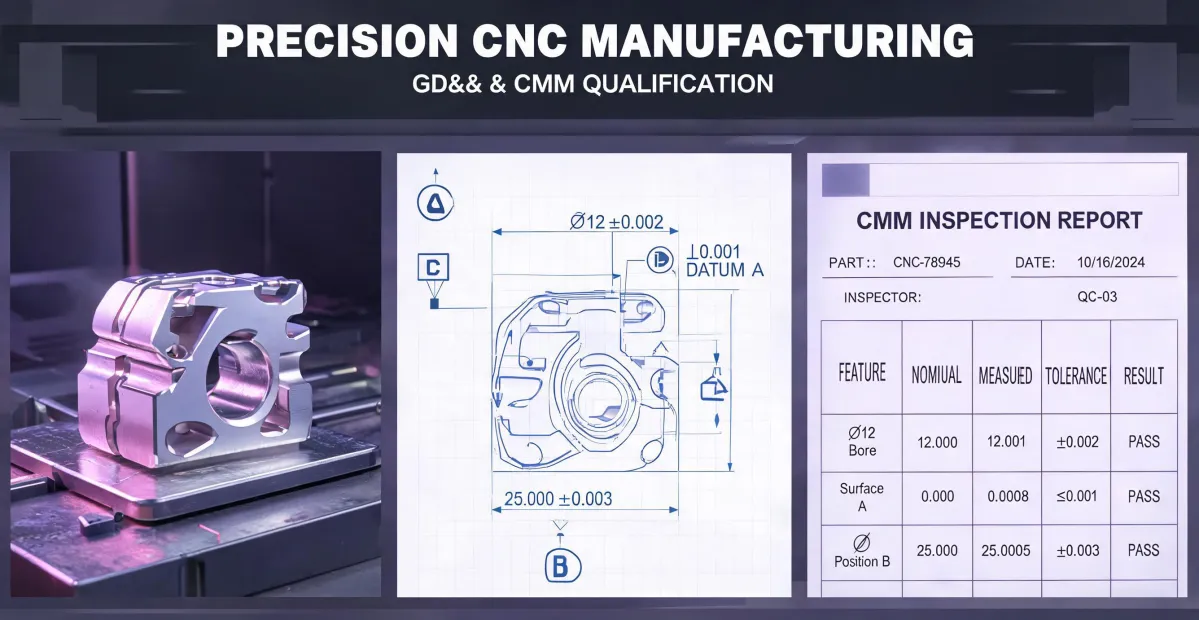
"CNC vs VMC" is the wrong question for most job shops. I'm not saying the differences don't exist. I'm saying the debate is a distraction. The question you should be asking is whether your tooling, your training, and your process can handle the machine you're about to put on the floor.
I've been handling tooling and CAM workflow for a 15-person custom machining shop since 2017. I've personally made and documented 11 significant mistakes, totaling roughly $17,000 in wasted budget. Now I maintain our team's pre-flight checklist, partly because I'm tired of being the guy who explains to the owner why an expensive machine didn't solve a process problem.
I'm not a machine design engineer, so I can't speak to spindle stiffness or thermal growth calculations. What I can tell you from a procurement-and-process perspective is that the machine was rarely the weak link.
CNC vs VMC: Why the Question Misses the Point
In common shop talk, "CNC" gets used as a machine, and "VMC" gets used as a category. But CNC vs VMC only matters at the level of control and architecture. A VMC control panel will tell you where X, Y, and Z are. A DMG MORI control does that, plus it asks you to think about 5-axis planes and collision avoidance from the first setup. If your team's muscle memory is built around a generic VMC control panel, the learning curve isn't a minor inconvenience.
Five years ago, we might have bought a machine and learned on the job. In 2025, that's a luxury you can't afford. The preparation happens before the machine lands: simulator, post-processor, training, tooling maps. What was best practice in 2020 doesn't apply the same way now. The fundamentals haven't changed, but the execution has transformed.
The Tooling Mistake That Cost Me a Week
Let me give you the exact example that changed my tooling policy. In 2019, I found a tin coated end mill factory in China that offered a price I couldn't ignore: about 60% lower than the premium supplier we used. The factory had good reviews, so I ordered 100 pieces. The first 10 looked fine. The 11th one sounded different on the first pass. On a slower, less rigid VMC, that variation might have shown up as a slightly shorter tool life. On a CNC DMG MORI, it showed up as a ruined part. Actually, it showed up as 12 ruined parts before I stopped the process.
I wanted to blame the factory. But I hadn't specified taper tolerance, coating thickness, or substrate quality. The factory made what I asked for — I just didn't know how to ask. That error cost about $1,800 in scrapped parts and a week of schedule. The machine didn't do that. My assumptions did.
This is the pattern that repeated itself for two years. Every time something failed, the machine was the easiest thing to blame. It was also the most expensive thing to blame, because replacing the machine wasn't an option. Replacing my assumptions was.
The Control Panel Assumption
Second mistake: I assumed anyone who could run a VMC control panel could walk up to a five-axis DMG MORI and at least navigate the basic screens. That assumption cost us a full day plus a near-miss that felt like a crash. Surprise, surprise: a control panel is not just a control panel.
A friend who programs for a shop told me, "the post is everything." I thought he was being dramatic. Then in September 2022, I loaded a program that worked on a 3-axis VMC and didn't adjust the post for the B-axis. The machine didn't crash, but it made a move that would have crashed if the operator hadn't caught it. Two days lost. I'm not a CAM software specialist, so I can't explain every parameter. What I can tell you is that "it worked on the other machine" is a terrible phrase to hear in a machine shop.
When I finally created a DMG MORI login, I found the course schedule, the machine manual, and the post-processor library. According to the official portal (checked March 2025), that documentation had been there the whole time. Which, honestly, made it worse. Note to self: log in before the PO, not after.
The Software Layer Is Not Optional
I used to think the machine was the machine and the software was something you dealt with on your laptop. In 2025, that line is gone. The CAM program, the post-processor, the simulation, and the machine are one system.
After the post-processor incident, I stopped calling it "just a software problem." That phrase is a red flag. If the simulation doesn't prove out, the machine won't care. It will make the move you asked for and let the chips fall where they may.
What surprised me most was how much of this lived in the DMG MORI login. I found webinars, training files, and a post-processor library. None of it was hidden. I just hadn't looked because I thought I didn't need it.
But Aren't the Fundamentals the Same?
Yes. And no. The fundamentals of cutting metal haven't changed: tool meets part, speed and feed matter, chips have to go somewhere. But a 5-axis machine with automation gives you more ways to make the wrong decision faster.
Some people will say, "a CNC is a CNC, a VMC is a VMC." That's true if you treat them like black boxes. But if you're using a five-axis machine to do 3-axis work because nobody can program the fifth axis, the machine is a very expensive VMC. I'm somewhat guilty of this during the first six months. The fix wasn't to downgrade the machine; it was to upgrade the plan around it.
I can only speak to high-mix, low-volume job shop work. If you're making 10,000 identical simple drilled parts, you don't need a 5-axis DMG MORI, and almost nobody is arguing that you do. But if you're quoting complex aerospace or mold work, the CNC vs VMC question is a distraction from the real issue: readiness.
What I'd Tell Myself Before the Machine Arrived
I went back and forth between a used 5-axis DMG MORI and a new 3-axis VMC for two weeks. On paper, the VMC made sense: cheaper, familiar, lower risk. My gut said the parts we wanted to quote would need a tilting table. I chose the 5-axis. That part of the decision was right. I wish I had chosen the preparation that came after it as carefully.
If you're in this position, start with three things. First, tooling: specify coating, tolerance, and substrate. Do a test cut before running production. Factories in China can be excellent — I'm not anti-import — but you need to verify, not assume. Second, training: if the control panel is different, budget for formal training before arrival, not after. Third, digital setup: create the DMG MORI login, download the post, simulate toolpaths, and run air cuts before the first real part.
Even after choosing the DMG MORI, I kept second-guessing. What if we should have bought the safer machine? The first two weeks were stressful. I didn't relax until we ran a part that measured well. But the doubt came back every time I saw a mistake that was mine, not the machine's.
Let me be clear about the boundary. I'm not saying every shop needs a 5-axis DMG MORI. If your work is simple boxes and drilled plates, a quality VMC is probably a better use of capital. But the discipline of preparing before you buy applies just the same.
So, CNC vs VMC? Wrong question. The right question is: are you ready for the machine you're asking for? If your tooling, training, and post-processor are dialed in, the machine will do what it says. If not, it will show you every weakness you have — often one scrap part at a time.
Now I maintain our checklist so the next person doesn't repeat my 11 mistakes. We've caught 47 potential errors using it in the past 18 months. That's not because I'm smart. It's because I stopped pretending the machine was the problem.