-
You Ordered 500 Parts. 47 Didn't Fit.
-
The Surface Problem: “It Passes Inspection, Doesn’t It?”
-
Deep Cause #1: We Use the Same Words, But Mean Different Things
-
Deep Cause #2: The Penny‑Wise, Pound‑Foolish Vendor Choice
-
The Real Cost: It’s Not Just the Rework
-
When Advanced Solutions Actually Help (And When They Don’t)
-
So, Is CNC Machining a Trade?
You Ordered 500 Parts. 47 Didn't Fit.
That sinking feeling when the assembly line stops. The gauge says 10.02 mm, but your print called for 10.00 ± 0.01. You call the vendor. They insist it's “within industry standard.” Sound familiar?
I’m the guy who sees this every week. As a quality compliance manager for a mid‑size precision machining supplier, I review roughly 200 unique items annually — from aerospace brackets to automotive spindles. In Q1 2024 alone, I rejected 15% of first deliveries. Not because the parts were unusable, but because they didn’t meet the spec we agreed on. And that gap — between “usable” and “spec” — costs way more than most people realize.
Let’s dig into why this happens, what it actually costs, and when a solution like DMG MORI’s 5‑axis machining centers or automated Y‑axis lathes genuinely makes sense (and when it doesn’t).
The Surface Problem: “It Passes Inspection, Doesn’t It?”
The most common conversation I have starts with a customer saying, “The parts work fine, so why reject them?” That’s the surface problem — people confuse function with compliance. A hole that’s 0.02 mm oversize might still accept the bolt, but it creates play that shortens assembly life by 30% over 10,000 cycles. Or it causes vibration in a high‑speed spindle, leading to premature bearing failure.
Here’s the thing: most buyers aren’t trying to cut corners. They just don’t realize that a tiny deviation today becomes a major warranty claim tomorrow. They see CNC machining as a trade — “just push a button and out come perfect parts.” But real quality isn’t automatic. It’s a process that starts with how you talk about specs.
Deep Cause #1: We Use the Same Words, But Mean Different Things
I once wrote a specification: “Thread depth: 12 mm.” The supplier interpreted it as “major thread depth” (including the chamfer). I meant “effective thread depth” (after the chamfer). The result: 800 parts with threads 1.5 mm too shallow. We discovered this when the bolts bottomed out during assembly.
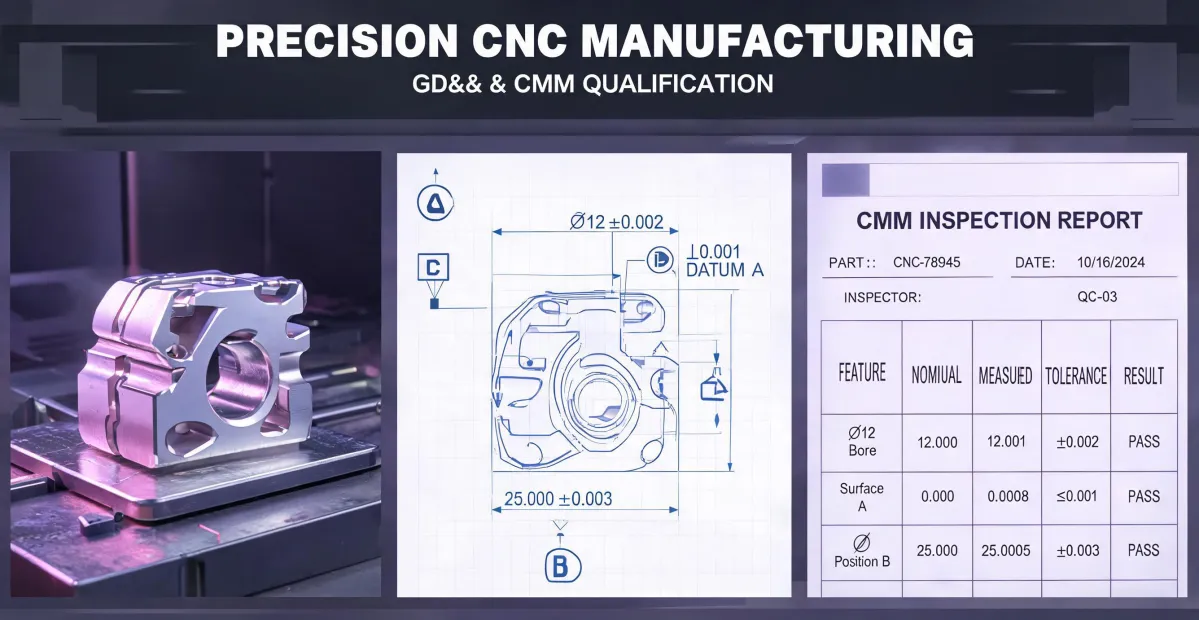
That’s a communication failure — one of the most common and expensive mistakes. Engineering drawings use GD&T (Geometric Dimensioning and Tolerancing) for a reason, but not every shop reads it the same way. I’ve seen “standard tolerance” mean ±0.1 mm to one vendor and ±0.05 mm to another. No malice, just different internal standards.
The fix is painfully simple: define every critical tolerance in writing, with a reference to an industry standard. For example, “General tolerances per ISO 2768‑mK” removes ambiguity. Yet I’d estimate 40% of incoming orders don’t include such a reference. We started adding it to every contract after that 800‑part disaster — and our first‑article rejection rate dropped by half.
Deep Cause #2: The Penny‑Wise, Pound‑Foolish Vendor Choice
Every procurement manager loves a low quote. I get it. But I’ve seen the same pattern repeat: a buyer saves $80 per part by going with a shop that uses older CNC equipment (maybe a 10‑year‑old Haas or Mazak, not bad machines, but not calibrated for tight tolerances). The first batch looks okay, but the second batch drifts. Then the third has a 0.03 mm shift because the machine wasn’t temperature‑controlled.
I call it the penny‑wise trap. Let me give you a real example: A customer saved $500 on a 100‑part run by choosing a budget vendor. The parts arrived and 12 were out of tolerance. They tried to rework them in‑house — cost another $1,200 in labor and material. Then the reworked parts still didn't assemble correctly, so they had to scrap them and reorder from a qualified shop. Total net loss: $1,800. The “savings” was an illusion.
This isn’t about bashing budget shops — some are excellent. But when the spec is tight (±0.01 mm or less), you need equipment that can hold that consistently. A DMG MORI 5‑axis machining center, for instance, has built‑in thermal compensation and vibration damping that older machines lack. Is it more expensive upfront? Yes. But for a production run where every part must fit perfectly, it can be the cheaper option in the long run.
The Real Cost: It’s Not Just the Rework
Beyond the direct financial hit, quality problems have hidden costs that don’t show up on a PO:
- Delayed time to market – A three‑week reorder pushes your product launch. Revenue lost? Maybe $20,000 per week.
- Brand damage – If your customer receives bad parts, they remember. Trust erodes faster than you can rebuild it.
- Internal friction – Engineering blames procurement, procurement blames the vendor, and everyone wastes hours in meetings.
I’ve seen a single quality issue cost a company $22,000 in redo costs and delay a product launch by six weeks. The root cause? A spec that wasn’t communicated clearly. The “solution” (rework) cost 4× the original part price.
When Advanced Solutions Actually Help (And When They Don’t)
This is where the honest limitation comes in. I recommend DMG MORI’s equipment — like their robot‑tended Y‑axis lathe or laser welding machines from their partnership with Trumpf — for high‑volume, tight‑tolerance work where consistency is non‑negotiable. For a job that requires ±0.005 mm on a 50‑part prototype, a brand‑new DMG MORI will outperform a manual mill every time.
But I also tell clients: “If your tolerances are generous (±0.1 mm) and your volumes are low, you can probably get away with a well‑maintained older machine. The upfront cost of a new machining center won’t pay back in that scenario.”
That’s the kind of honesty that builds trust. I’d rather lose a sale to a customer who genuinely doesn’t need the capability than sell them something that’s overkill and have them feel burned later.
So, Is CNC Machining a Trade?
Yes — but not in the way most people think. It’s a trade of precision, communication, and process discipline. The machine is just a tool. Whether it’s a DMG MORI 5‑axis or a Haas VF‑2, the real quality comes from how you define the spec, how you verify it, and how you choose a partner who can hold it.
If you’re sourcing machined parts and wondering why they don’t always fit, start with your specification. Ask your supplier: “What tolerance standard do you default to?” and “What’s your Cpk on critical dimensions?” If you get a blank stare, that’s a red flag. If you get a confident answer backed by data — you’ve found a partner.
As of Q1 2025, I can tell you: the market is full of shops that promise “ISO 9001 quality,” but few deliver consistent Cpk ≥ 1.67 on every feature. The ones that do? They’re usually investing in modern equipment like DMG MORI, they’re training their operators in GD&T, and they welcome your inspection — because they know their parts will pass.
This worked for us, but our situation is a mid‑size B2B operation with predictable monthly volumes. If your business is seasonal or you produce prototypes in batches under 20 units, the calculus might be different. Feel free to run your own math — and always verify current pricing before committing.