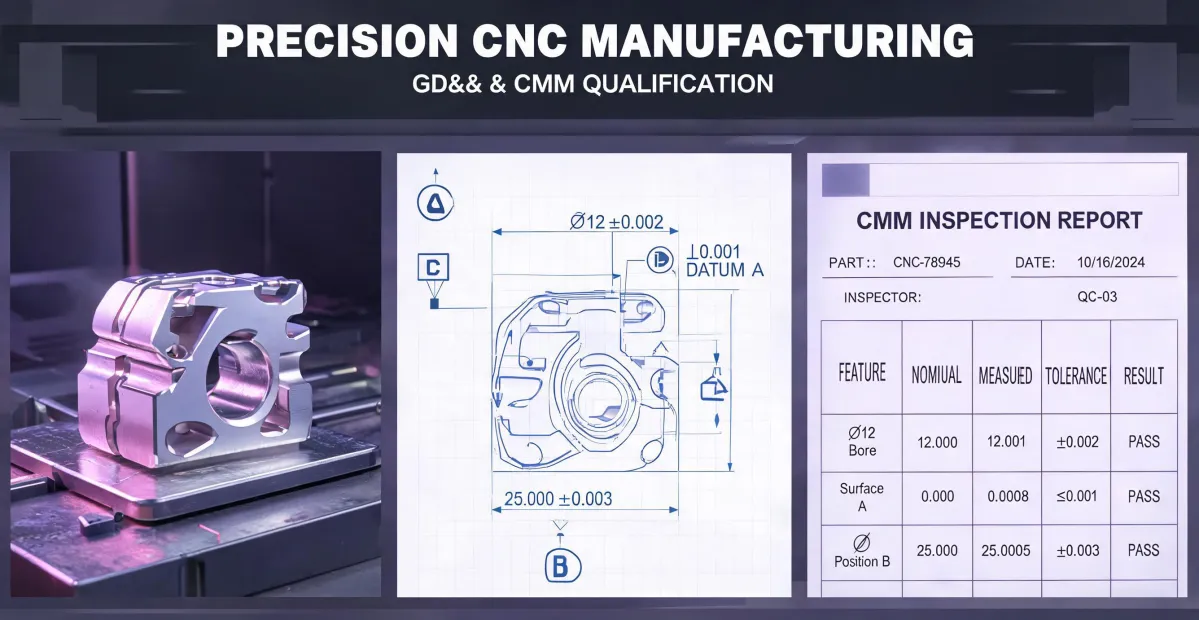
Here's what a $3,200 tooling mistake taught me: the purchase price of a CNC machine is maybe 40% of what it actually costs to put that machine into production. The other 60%—automation, tooling, programming, training, rework, downtime—is basically where you win or lose. I now calculate total cost of ownership (TCO) before comparing any machine quotes, including DMG MORI. This isn't a sales pitch for expensive machines. It's a note from someone who paid the tuition.
I'm a process engineer at a 30-person contract machining shop, and I've been handling CNC orders for six years. I've personally made—and documented—13 significant mistakes, totaling roughly $27,000 in wasted budget. In my first year (2017), I made the classic mistake of choosing a machine based on spindle speed and axis travels. But the one that still makes me wince happened in September 2022.
The $3,200 insert chart lesson
We took on a repeat order for a DMG MORI NLX 2500 with a Y axis and a robotic cell. I was very excited about the robot. Actually, the automation was the whole reason I wanted this project. It would cut labor hours, and the control had good simulation. So I approved the integration package and skipped the tooling review. I didn't check the lathe carbide insert chart. The machining looked fine. The CMM said otherwise. 47 pieces, $3,200, straight to scrap.
Everyone warned me about tooling selection. I nodded. Then I skipped the step and paid the tuition. The DMG MORI CNC was stable the entire time—the machine wasn't the problem. The problem was my assumption that the insert grade for the previous steel job would work on the cast iron part. I should add that the correct grade was right there in the cabinet, three minutes away. The most frustrating part: you'd think an engineer with six years of experience would check a simple chart before a batch. But I didn't.
I didn't fully understand the value of an insert chart until the CMM report came back. The machine didn't care. The chart didn't care. The checkbook did. Oh, and the $3,200 didn't include the overtime our team spent reworking the schedule. That's when I stopped comparing machines at the specification level and started comparing them at the "what can go wrong" level.
What TCO actually includes on a DMG MORI line
Here's how I think about it now. TCO for a machine like a DMG MORI CNC is not a single number; it's a stack of numbers:
- Machine base price
- Rigging, foundation, coolant, and air supply
- Automation integration—a robot for DMG MORI Y axis lathe is not a bolt-on
- Tooling package and insert grades
- Post-processor, simulation, and programming time
- Operator training before production
- Spare parts and service response time
- Downtime cost when something fails
- Scrap/rework risk from the first batch
When you quote a robot for DMG MORI Y axis lathe, the robot arm might be 30% of the project. The rest is the safety cell, grippers, software, part detection, and your own people learning to trust it. If you price only the robot, you'll approve a project that blows the budget before the first chip hits the conveyor.
Before the robot, I assumed a robot for DMG MORI Y axis lathe would simply load parts and go. It didn't. We spent a week aligning grippers, proving the cycle, and teaching the operator how to recover from a stuck jaw. That week wasn't in the quote. It's in the TCO.
The same logic applies to tooling. I now keep a laminated lathe carbide insert chart next to every CNC lathe, and we record the ISO 513 application group before high-value runs. Sounds almost stupidly simple. But our 2024 audit showed that one habit caught 11 potential wrong-grade selections before they cost us a single part. After the third rejected batch in Q1 2024, I moved the insert check to step one on the pre-production checklist.
I once compared two tooling distributors for the same insert. One priced it at $11, the other at $14. The $11 quote became $16.80 after minimum order, packaging, and freight. The $14 quote included next-day delivery and free technical support. Same insert, opposite TCO. The cheap one was actually the expensive one.
The brand question is a TCO question
I can search "dmg-mori" or "DMG MORI" and get the same marketing pages. None of them show the TCO number. The DMG MORI name carries a premium, and I've also seen that premium paid back in resale value and application support. But that's not a guarantee; it's an input to the calculation. There were two times I rejected DMG MORI quotes because our region's service response time didn't justify the premium. Sometimes the honest answer is to buy a used machine and spend the savings on tooling and training.
Does that mean DMG MORI is overpriced? No. It means the "best" machine is only the best when the total cost model says so. At least, that's been my experience with small-lot production and aerospace customers.
Aerospace and alternative processes need the same math
TCO thinking also changes how I read technology comparisons. A customer once asked us to evaluate a laser cutting machine for aerospace industry components. The laser quote was higher than the waterjet quote. But after plate nesting, secondary deburring, and kerf-width accounting, the 6 kW laser had a lower per-part cost in our simulation. It's not that laser is always the answer; it's that the comparison only works if you include the steps after the cut.
I also get the question "electron beam welding vs laser beam welding" about once a month. EBW generally has a higher upfront chamber cost and vacuum pumping time, but it produces a deep, narrow weld with a small heat-affected zone. Fiber laser welding usually wins on cycle time and flexibility. My answer is always the same: which one lowers your total cost per good weld, not which machine has the lower sticker price.
If you work in aerospace, AS9100 makes this even more urgent. Tooling control, process traceability, and configuration management are audit requirements. A cheap quote that creates an audit headache is not cheap.
Where I still ignore TCO
I don't want to make this sound like a magic formula. TCO thinking has limits. If your shop has very low utilization, a premium machine's reliability might never pay for itself. If you're prototyping one-off parts, a standard 3-axis mill may be the right call. I also won't pretend DMG MORI is correct for every shop. We bought a small, older CNC lathe from a different manufacturer in 2024 because the compact footprint fit a temporary cell. It was the right decision, and it still is.
The point isn't to make every purchase expensive. It's to stop making purchase decisions based on one number that doesn't include the afternoon your operator spends relearning the control, the third shift you lose to a tooling issue, or the rush freight for a $90 insert that should have been in stock.
Before you sign anything
This is the checklist I use as of January 2025. It's not a perfect formula, but it would have saved me $3,200.
- Write down the list price.
- Add rigging, utilities, and installation.
- Add automation integration, including every sensor and interface.
- Add the tooling package and review the insert chart with your lead machinist.
- Add operator training and a realistic ramp-up curve.
- Add the cost of one scrapped batch and one week of downtime.
- Subtract expected resale or labor savings—but only if you're honest about utilization.
Bottom line: I don't think you should buy a DMG MORI because of the name. I think you should buy it because your total cost model says it fits your part mix, your automation plan, and your tolerance requirements. And if someone hands you a quote that looks cheap, ask them to include the insert chart, the robot gripper changeovers, and the first rework, not just the machine price.