I'm an applications engineer who has handled CNC and additive machine evaluations for the last eight years. I've personally made—and documented—about $50,000 worth of wrong assumptions. Somewhere in the middle of that, I started maintaining a checklist. If you're looking for what to know about 3D printers before buying, this is that checklist, framed as a comparison.
Why compare a dedicated 3D printer to a hybrid machine?
Most comparison guides start with price. I start with the process. The market is really offering two paths:
- Option A: a dedicated 3D printer — a powder-bed or material extrusion machine that builds parts layer by layer, then sends you to another process for finishing.
- Option B: a hybrid additive/subtractive machine — a CNC platform that can deposit or fuse material and then machine it in the same setup. DMG MORI's laser-based additive machines are in this category.
I'll compare them across five dimensions: tolerances, tooling, laser source, total cost, and skill. Additive manufacturing terminology is defined in ISO/ASTM 52900:2021, but the standard won't tell you whether a specific machine makes a good part. You have to compare with your parts in mind.
1. Tolerances and surface finish
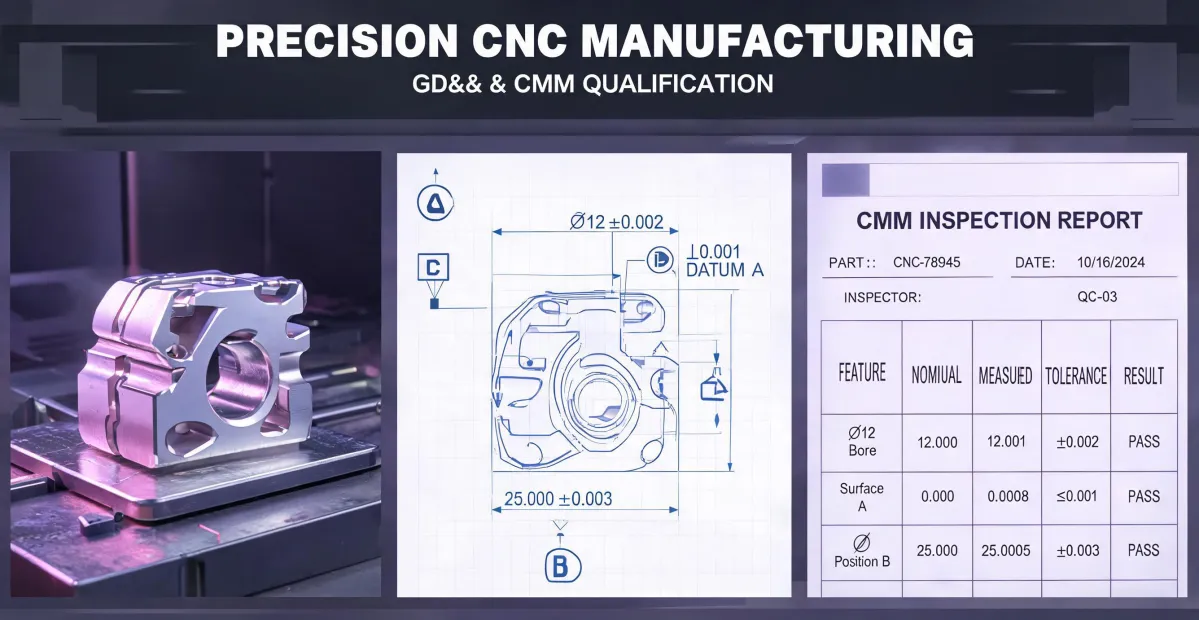
A dedicated 3D printer is a roughing process. The part comes out with surface roughness, residual stress, and layer steps. If your drawing says something like ±0.0005 inch, you won't print that. You'll machine it.
A hybrid machine changes the sequence. The laser deposits near-net geometry, and the spindle finishes it before you break the setup. Same coordinate system, less re-fixturing error.
Here's where my checklist started. In September 2022, I approved a $4,200 titanium bracket produced on a standalone metal printer. It looked fine on my screen. It always does. Then we put it on a CMM and found a bore that was +0.006 inch over. We had to EDM out the excess, reprint, remachine, and re-treat it. That's a three-week lesson.
The counterintuitive conclusion: the cheaper printer costs more per good part once you add post-processing. If you don't have a reliable way to finish printed parts, you're not buying a 3D printer. You're buying a problem that takes longer to appear.
2. Tooling and the machine ecosystem
Nobody buys a 3D printer thinking about tool holders. That's the trap.
If you already run a machining center, tool holder selection determines whether a hybrid machine earns its keep. The spindle doesn't care whether you're loading a shell mill or a deposition nozzle. It cares about taper, pull stud, runout, and balance.
I once ordered $1,800 worth of standard ER collet holders because the brochure didn't specify the interface. The machine had HSK-T63. We didn't catch it until setup day. Looking back, I should have confirmed the spindle interface before buying anything. At the time, the sales sheet just said “HSK” and I assumed BT40. (Never assume spindle interface.)
If you're evaluating a DMG MORI machine, search for dmg mori tool holders before you sign anything. There is no universal holder. There is only what matches your machine.
3. Laser source and delivery
Lasers in manufacturing aren't new. The CO2 laser was invented in 1964 by Kumar Patel at Bell Labs, and the technology has been iterating ever since. But a laser for welding isn't automatically a good laser for additive manufacturing. Beam mode, wavelength, and focal geometry make more difference than peak power.
In a direct energy deposition (DED) system, the beam often travels through a laser fiber cable to the deposition head. That cable is a consumable. The surprise wasn't the laser power in the spec sheet. It was the cost of a fiber cable after a robot path collision. In Q1 2024, we sheared one because the program wasn't fully verified. Replacement plus downtime: about $2,100.
So when you compare machines, ask what happens when the laser delivery path gets damaged. Ask how long the laser fiber cable takes to replace. Ask for the price. If the salesman hesitates, that's a response.
4. Total cost and floor space
This is where the spreadsheet got ugly. A dedicated printer had a lower sticker price. The hybrid machine had a higher quote. But the standalone path also required:
- a CNC mill for final machining,
- heat treatment or stress relief,
- more work-in-progress movement between departments,
- an extra inspection setup.
I calculated the worst case: a complete redo at $3,500 plus a missed delivery. The best case: save $80,000 on the initial purchase. The expected value said go standalone, but the downside—late parts, multiple vendors, and alignment corrections—felt catastrophic. I went with the hybrid approach. It wasn't the cheapest line item. It was the shortest path to a good part. (That's the number that matters.)
If you tell yourself “we'll send it out for post-processing,” ask how you'll react when the outside shop says two weeks. Outsourcing creates queues. Queues create missed deadlines.
5. Operator skill and programming
A standalone 3D printer is friendlier to a new user. Load the file, slice, start. A hybrid machine requires CAM knowledge, collision checking, tool holder selection, and an understanding of both additive and subtractive process windows.
But the gap is smaller than you'd think for a machinist. A machinist already thinks about fixturing, work offsets, and spindle load. The hybrid machine lets them use that experience. The operator doesn't need to know everything about lasers. They need to know that lasers are one more tool in the machine.
What was best practice in 2020 may not apply in 2025. The fundamentals—fixturing, tool path, material, inspection—haven't changed. The execution has transformed.
Which should you buy?
There's no universal answer. The decision depends on the part you're making and the skills you already have.
- Choose a dedicated 3D printer if you need polymer prototypes, small quantities, loose tolerances, and time to develop a post-processing workflow.
- Choose a hybrid additive/subtractive machine if you need metal production parts, tight tolerances, or a way to reduce setups in an existing machine shop.
- If you already run DMG MORI machines, start at the DMG MORI homepage and look at the actual product matrix. Reseller summaries don't always show the option list.
As of February 2025, machine configurations and software versions change quickly. Verify current specifications before you budget. The goal isn't to buy the most advanced machine. It's to avoid the second setup.
If I could redo my earlier purchases, I'd invest more upstream in integration. But given what I knew then—mostly pretty homepage images and cheerful spec sheets—my choice was reasonable. The next one won't be.
And when someone says “this 3D printer replaces CNC,” ask one question: what's the tolerance? The 3D printer doesn't replace the CNC. It just moves the work to the next setup.