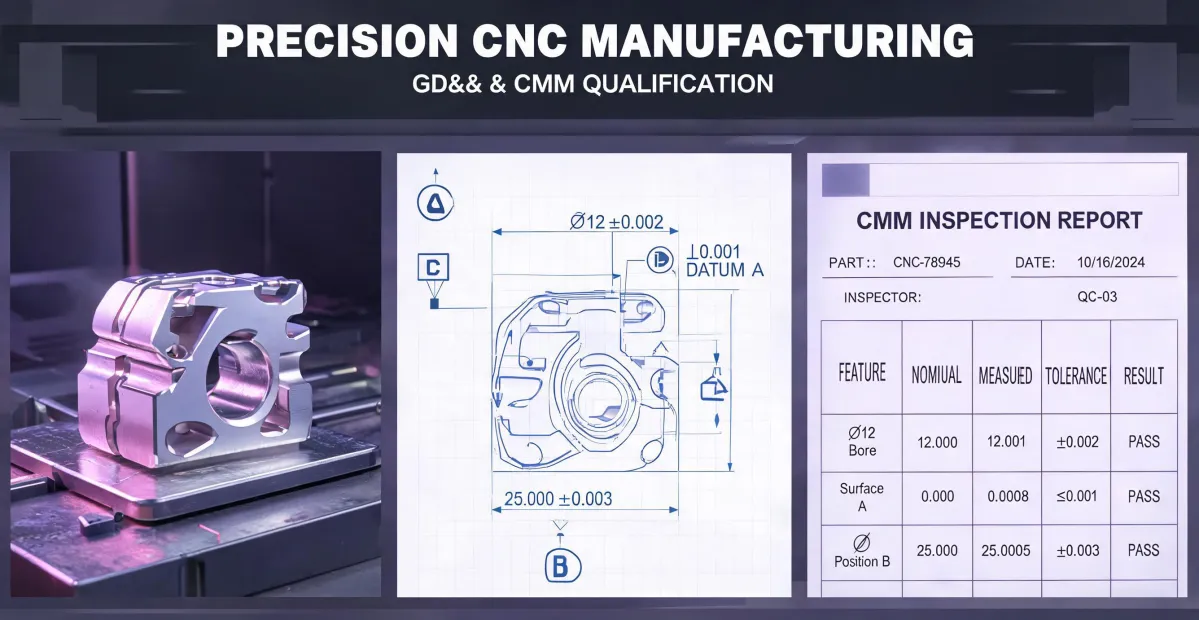
At 4:30 PM on a Friday, I got the call that starts about forty conversations a year: 'We need 14 components by Monday morning.' The client had a molding line down. Normal lead time for that part was two weeks. We had roughly 60 hours, a DMG MORI milling machine, a CNC lathe, and a choice to make. I've coordinated 200+ rush orders over eight years, and this one had all the warning signs.
That's when I realized the real problem wasn't the deadline. It was how we think about machines and cost.
The Problem I Thought We Had
At first, the problem looked like time. The client didn't give enough lead time. But time only exposed a deeper issue: the part was a prismatic housing with tolerances on three faces. A lathe can do a lot, especially with live tooling. But it is not the right process for a part like that. We could make it, but only with extra setups, custom fixturing, and a lot of babysitting.
That's where the CNC machine vs lathe question gets confusing. It looks like a comparison between two products. In reality, it's a comparison between two part geometries and two very different risk profiles. A milling machine removes material with a rotating spindle and lets the part move through multiple axes. A lathe spins the workpiece while a fixed tool cuts it. Both are CNC. They just ask different things from the operator, the tooling, and the process plan.
The Problem I Didn't See at First
The deeper problem is that most of us choose the machine before we really understand the part. We have an open spindle, so the job goes there. The lathe has a lower hourly rate, so the quote goes there. We've done it a hundred times. I've done it myself.
In March 2024, I had an order for a client in aerospace. The drawing called for a six-sided bracket with critical holes on two faces. Our first instinct was to use the DMG MORI milling machine, but it was booked for another rush job. So the estimator suggested the lathe with live tooling. 'We can index it,' he said. I said okay without checking the drawing myself. That was my mistake.
The lathe could cut the features. It just couldn't hold the relationship between them. After three test pieces, two surfaces were already drifting out of tolerance. We stopped, waited for the milling machine to free up, and finished the job 11 hours before the deadline. If I hadn't checked the drawing before accepting the estimate, we'd have missed it. The contract had a $50,000 penalty clause.
I learned two things from that. First, never assume a machine can do something just because it technically can. The setup may be so complex that the time and scrap eat any savings. Second, the machine you already have is often the most expensive option, because it forces the part to fit a process that doesn't match it.
The Real Cost of the Wrong Machine Choice
This brings me to total cost of ownership (TCO). It's easy to compare machine prices, hourly rates, or spindle speeds. But the real costs pile up where most quotes don't look:
- Setup and changeover time. Changing from a lathe setup to a milling setup isn't a 20-minute adjustment. It can burn half a day, or a full shift in rush mode.
- Fixturing and workholding. A prismatic part on a lathe needs custom jaws, a sub-plate, or a third-party fixture. That fixture costs money and lead time.
- Second operations. If the lathe can't reach a face or hold an angle, the part goes to a second machine. That's another setup, another queue, another chance for handling damage.
- Tolerance drift. On a mismatched process, tolerances drift as tools wear and heat grows. Scrap in a rush order is not a small line item; it's a missed deadline.
- Expedite costs. When we outsource an emergency operation, we pay premium freight and rush fees. That instantly wipes out any savings from choosing a lower cost process.
- Opportunity cost. The wrong job ties up a machine that could be making money on a better fit.
Last quarter, we tracked 47 rush orders. The jobs that went on the right process had 18% lower total cost than the ones we forced onto a mismatched machine. That number doesn't come from a manual; it's from our own job records. In my experience, a machine choice is a total-cost choice, not a list-price choice.
What a Fiber Laser Workstation Has to Do With Any of This
This is where the conversation gets uncomfortable for people who only think about cutting tools. Sometimes the cheapest way to save a component is not another CNC milling pass. It's a different kind of energy altogether.
In one repair job, a die insert had a worn edge that needed material added back. A new insert would have required 12 days of lead time and a long machining sequence. Instead, we used a fiber laser workstation to build up the surface and then did one light finishing pass. The CW laser welding process made no sense on paper if you looked only at the hourly cost. It made total sense once you counted the cost of downtime: the line was down at $1,800 per hour. The repair took less than four hours. The alternative was days of downtime.
I'm not a welding engineer. I can't talk about beam focus or metallurgical details. What I can tell you from a production perspective is that the best machine for a job is sometimes a laser work cell, not a lathe or mill. That's a hard lesson for shops that organize everything around a CNC machine vs lathe debate.
Why I Keep Checking the DMG MORI Official Site
People ask why I keep going to the DMG MORI official site (dmgmori.com, accessed March 2025) when I'm triaging an order. It's not for marketing brochures. I think the official spec pages are useful because they separate turning, milling, and laser machinery into different categories. That sounds obvious, but it still helps me ground a decision when someone says to just use a CNC machine.
The DMG MORI milling machines in our shop are not lathes with a bigger turret. They have different spindle orientation, different tables, and different kinematics. A lathe, even a very good one, is still designed primarily for rotationally symmetric work. The CW laser welding systems and fiber laser workstations serve a third purpose entirely: adding material, repairing surfaces, and, in many cases, avoiding the need to cut a whole new part from billet.
The spec pages on the official site are a good starting point for a TCO analysis, but they are just a starting point. I still have to talk to the person who will set the job up. I still have to look at the part drawing. I still have to ask what happens if it goes wrong.
A Better Question Than CNC Machine vs Lathe
So here is what I have learned after years of rush orders: stop asking which machine category is better. Ask what the part actually requires.
- Is the part rotationally symmetric? A lathe is probably the right starting point.
- Is it prismatic, with critical features on multiple sides? A milling machine or 5-axis machining center is likely the better choice.
- Do you need to replace damaged material? Maybe a CW laser welding workstation can save the part and the schedule.
- What is the worst-case cost of a failed setup? If the answer includes a penalty clause, choose the process with the least risk.
I'm not saying you should over-invest in exotic machinery. I'm saying the cheapest quote on the worksheet is not the cheapest outcome. The last time I chose the lower-priced route, we paid for it in extra setup time, more inspection, and a very stressful night. So glad the part made it in the end. But I don't want to repeat that.
Keep It Simple, but Don't Simplify It
If you're making a machine decision, do the TCO thinking before the emergency hits. Identify the processes that match your part mix. Use the DMG MORI official site or any other reliable source to understand what each platform actually does. Talk to someone who runs the machine, not just someone who sells it. And when the Friday call comes, you'll know which machine should get the part.
That's the emergency specialist version of a machine comparison: the right process, not the obvious one, is what saves the deadline.