I work as a quality/compliance manager at a contract manufacturing shop. I review roughly 240 part numbers every month, and in our Q1 2024 audit, 9% of first-piece samples did not satisfy the customer's intended use. The parts matched the drawings. That was the problem.
Take a recent order described as VMC fishing jigs. What I mean is that the customer wanted fishing jig heads made on a vertical machining center. We ran the first operations on a CNC DMG MORI machining center. The machine held position, the cutter left a clean surface, and the measurements were within print. The customer still rejected the lot after testing one prototype on an actual fishing line. A tiny burr inside the line-eye hole was cutting the line.
Nobody had specified an edge break on that hole. We debated whether this was a machining error or a documentation gap. The most frustrating part of that conversation was that everyone was technically right. The operator followed the print. The inspector accepted the part to spec. The customer used the part and it failed. That redo cost us about $22,000 and a week of hot-fix scheduling. It also made me rethink what quality means before the machine starts.
What I Normally Hear From Customers
When a customer calls, they often start with a machine name. They say, I want it made on a CNC DMG MORI. Or they name a process: Can you do DMG MORI additive manufacturing? Or they ask a tooling question: what tool is best for cutting plastic?
I understand why. Search results treat machines and tooling as the important part. But after reviewing many failed first articles, I'm somewhat skeptical of that framing. The machine name tells me about capability, not about what the part needs to do.
Let me give you another example.
The Question Hiding Behind Plastic-Machining Searches
One common search phrase is what tool is best for cutting plastic. The conventional answer is: use a sharp tool with high positive rake, control heat, and make sure chips do not melt back onto the cut. That answer is not wrong. But it rarely helps when a job goes sideways.
Everything I had read about machining plastic said cutter geometry is the first thing to check. In practice, I have watched two identical cutters behave differently because the toolpath and coolant strategy changed. What I mean is that chip evacuation and heat control mattered more than the tool brand. A polished carbide tool is often the right tool for cutting plastic, but only when it is part of a system that removes chips and prevents frictional heat from building up.
That is why I hesitate when someone asks a one-sentence tool question before sending a material datasheet. If the plastic is glass-filled nylon, the answer changes. If it is acrylic, the answer changes again. If you ask what tool is best for cutting plastic without saying which plastic, what tolerance, and what finish you need, you are still looking at the surface of the problem.
The Deep Issue: Starting With a Solution Before Defining Done
The deep reason for most failed jobs is not bad machines. It is unclear success criteria. A drawing can say drill 3 mm hole, but it does not explain why the hole exists. If the hole is a fishing line guide, a burr that would be harmless in a mounting bracket is a defect. If the part is plastic, edge quality means different things on a wear surface than on a cosmetic surface. An additive metal part can have a perfectly fused internal lattice and still be unusable if powder remains inside a channel.
Put another way: quality is not just what the machine produces. It is the match between the part and the conditions under which it will work. Those conditions need to be on the drawing, the purchase order, or the inspection plan. Otherwise quality is only a guess.
This is where I become direct. A CNC DMG MORI is an excellent, precise tool. It still cannot read intent. The same is true for DMG MORI additive manufacturing, or any machining center. The controller executes paths. It does not know that the line-eye hole is for braided fishing line and needs a deburred radius.
DMG MORI additive manufacturing is a different conversation in some ways. It can produce internal channels and lattice features that milling cannot reach. But those features also create new inspection problems. Surface finish from powder bed fusion is not the same as machined finish. Support removal can leave witness marks. Powder can hide in closed channels. None of that shows up in a build report unless you request it.
When we request quotes for additive work, I learn a lot from how a provider reacts. One vendor, Synergy Additive Manufacturing LLC, asked us to classify critical features before quoting. They wanted a table showing the test method, the instrument, and the acceptance limit for every feature that mattered. I do not know if they hit every target, but their quote made the risk visible. I am not sure why more shops do not do this. It is more useful than telling me their beam diameter.
The Cost of an Underdefined Part Is Not the Machine Hour
The expensive part of manufacturing is rarely the first mistake. It is the emergency that follows.
In March 2024, we paid $400 extra for rush delivery of a replacement plastic component because the normal delivery date would have caused us to miss a customer's production trial. Some people see rush fees as waste. I see them as buying certainty. The trial was worth $15,000 to that customer. An uncertain delivery or a repeated quality miss would have cost far more than that premium.
That is why I now apply the same logic to quality problems. An uncertain probably good part is more expensive than a deliberately inspected one. The $22,000 fishing jig redo was not really caused by the CNC DMG MORI machine or the person who ran it. It was caused by not defining what good looked like before cutting metal.
What I Ask Before I Approve a First Article
If you only take one thing from this, take it: define done before choosing a process. I now use a short checklist before writing a PO or starting a first article:
- Put the functional requirement on the drawing. For the fishing jig, that meant adding a note such as edge break must not catch braided line. That tells the machinist what matters, not just what size to hold.
- For plastic parts, specify the material grade, allowable witness marks, edge condition, and the surface roughness needed in the functional zone.
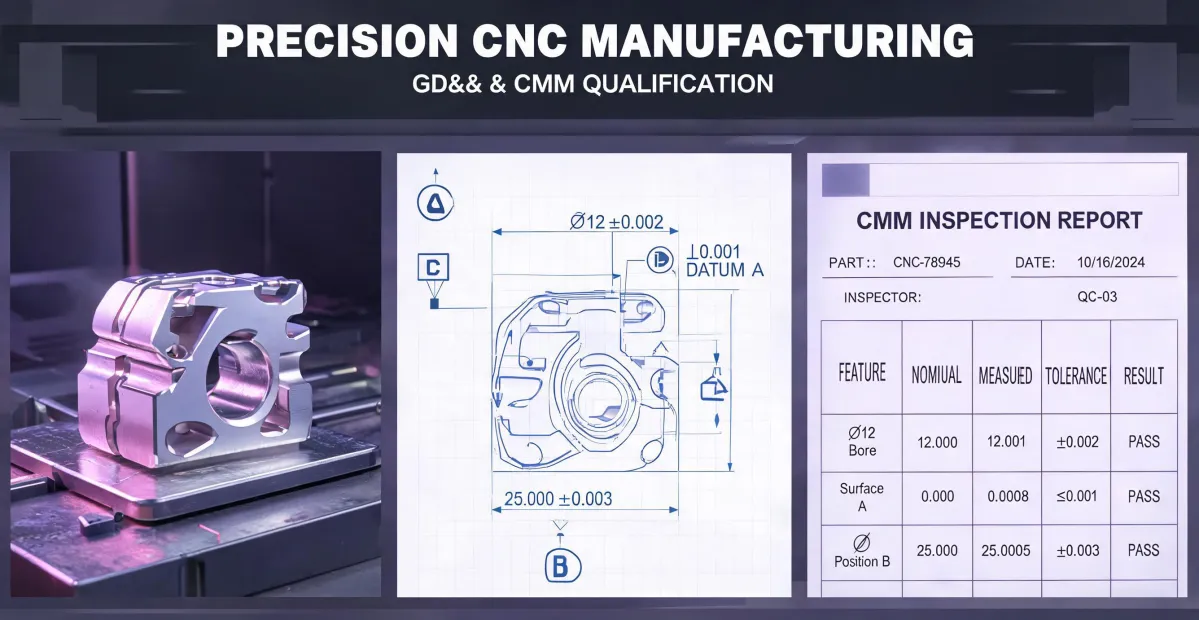
- Identify the features that will be inspected separately from the machine. Machine-reported positions are useful, but they are not the same as independent verification.
- For DMG MORI additive manufacturing or any powder process, specify support removal, internal channel cleanliness, post-machining allowances, and which surfaces are acceptable as printed.
The answer to the original tool question becomes easier after those details exist. A CNC DMG MORI can machine a fishing jig. DMG MORI additive manufacturing can produce geometry that would normally require assembly. But neither one can decide what good means. That decision has to happen before chips fly, before the laser starts, and before anyone writes CNC DMG MORI on a quote.