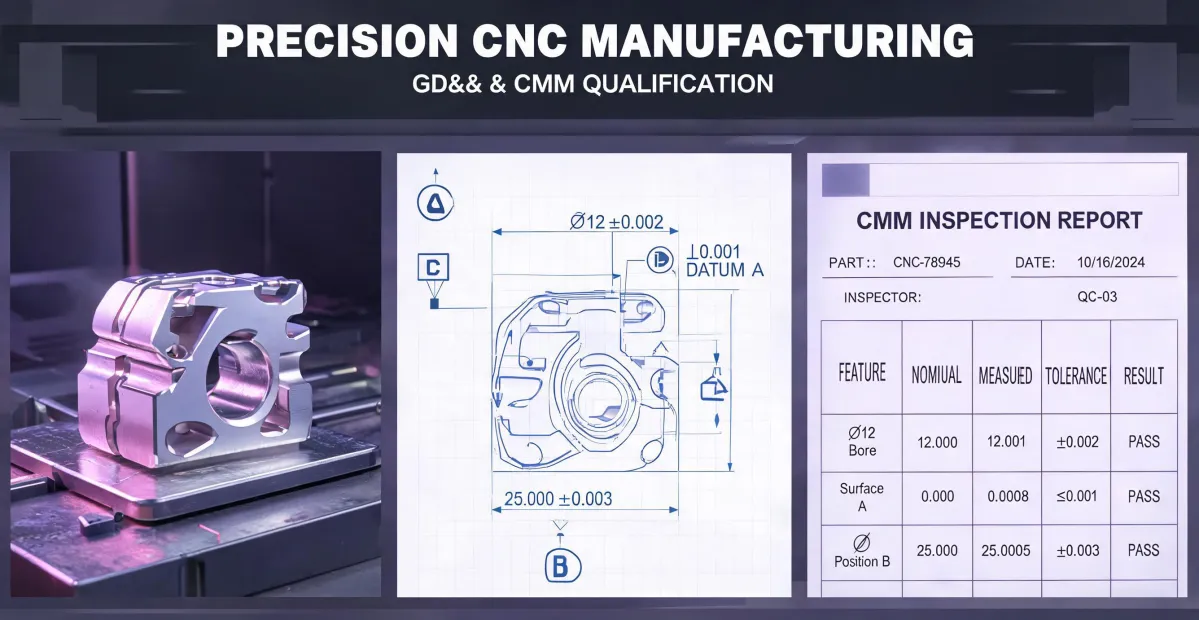
September 2022. Tuesday morning. Our DMG MORI machining center was running a 500-piece brass connector order, and every part that hit the inspection bench measured within the ±0.0005" print tolerance.
Then the 2 PM inspection batch failed.
Not by a lot. By 0.0007 of an inch. The kind of drift that won't set off alarms on a digital readout but absolutely fails a drawing callout. Forty-seven pieces, straight to the scrap bin.
If you've ever watched good parts turn bad for no visible reason, you know the sinking feeling that comes with it. I've been handling precision machining orders out of our shop in Cleveland, OH for eight years now. I've personally made and documented 23 significant mistakes in that time, totaling roughly $86,000 in wasted budget. This one wasn't the most expensive, but it was the one that permanently changed how I think about cutting fluid.
The Usual Suspects Were All Innocent
When parts start drifting out of tolerance mid-run, your brain goes to a short list. Tool wear. Program error. Fixture shift. Machine alignment. Ours did too.
We pulled the inserts and checked them under the microscope — plenty of life left. We verified the program, double-checked the work offsets, and re-indicated the fixture. We even ran a ballbar test on the machine. Everything came back clean.
Which is exactly the kind of result that should make you nervous. When all the obvious causes are eliminated, the real problem is something you haven't thought to look at. And we hadn't thought about coolant temperature.
A quick backstory on the customer: they originally brought us the part design as a printed prototype. First an FDM version, which proved the basic geometry but showed obvious layer lines. Then a PolyJet version, which looked far smoother — close to an injection-molded part at a glance. Their engineering team had spent weeks debating FDM vs PolyJet 3D printing for design validation, and honestly, both technologies did their job.
But the prototypes had zero relevance to the production challenge. The material was C36000 brass, the tolerances were tight, and the volume ran into the thousands. This was always going to be a machined part. All the prototyping effort in the world doesn't tell you how a material behaves when it meets a spinning end mill under flood coolant.
By Wednesday afternoon, the mystery was still unsolved. Parts would measure fine in the morning, drift at midday, improve after lunch, then fail again by the late shift. The pattern was there. We just weren't logging the one variable that explained it.
Then, around 3 PM, I rested my hand on the coolant return line while talking with one of the machinists. It was warm. Not hot. Just warm — noticeably warmer than the fluid had felt when I'd checked the tank that morning. It sounds kinda stupid in hindsight, but that hand-on-the-hose moment is what cracked the case.
The Real Culprit Was the Coolant Temperature
Here's something most people don't realize: CNC cutting lubrication has three jobs, and only two of them get any attention. The first job is lubricating the cutting edge. The second is chip evacuation. Everyone knows those.
The third job is thermal stabilization. Cutting fluid is the thermal bridge between the cutting zone, the spindle, the workpiece, and the machine structure. It absorbs heat from all of them, circulates it, and redistributes it. As the machine runs, that fluid slowly gets hotter. The coolant pump adds heat. Spindle bearings add heat. The cutting process adds heat.
By mid-afternoon, our coolant tank was sitting at 82°F. That morning, it had been 71°F. An 11-degree swing in one shift, with no regulation at all.
Now, what does that do to a brass part?
Brass has a coefficient of thermal expansion of about 11.2 × 10⁻⁶ in/in/°F — roughly double that of steel. On a 4-inch brass part, an 11°F temperature change shifts the part's dimensions by about half a thousandth of an inch, just from the material's own expansion.
Then the machine structure gets involved. The spindle housing, the ball screws, the column, the workholding — every steel element in the load path responds to temperature. A machining center with coolant circulating through it acts like a heat engine, and the entire structure grows or shrinks as the fluid temperature drifts.
Add the part's expansion to the machine's expansion, and you're looking at 0.0007 inches of total drift by the afternoon. Exactly what we were seeing. This is a documented enough phenomenon that ISO 230-3 exists — the international standard for testing thermal distortion in machine tools. It's not an obscure concern; it's a known variable in precision machining. I just didn't know it until that Tuesday.
The sneaky part is how well the evidence hides itself. The part cools down by the time it reaches the inspection room. The machine cools down overnight. Thursday morning, everything measured perfectly again. The error literally melted away before we could catch it.
Cleveland Made It Worse
Our shop is in Northeast Ohio, and that location had more to do with this failure than I initially understood. Cleveland's city water temperature swings more than 30 degrees between January and August — mid-40s in winter, mid-70s in summer. That's the water feeding our coolant mixers.
The starting temperature of our coolant was completely different by season. Same program, same tooling, same fixture, same operator — and parts measured differently in July than they did in January. Not because the process changed, but because the machine's thermal baseline was different.
If you're shopping for CNC machining in Cleveland, OH, or anywhere else with real seasons, ask this question before you place a tight-tolerance order: "How do you manage coolant temperature?" Most shops won't have a clean answer. We didn't.
What 47 Scrapped Parts Actually Cost Us
Direct costs first. 47 blanks at roughly $12 each — about $560 in raw material. Machining time down the drain — another $700. Then we ran the rework at our own expense, swallowing about $1,800 in labor to keep the account alive. If you're adding it up, that mistake hit us for just over $3,000 in visible costs.
The indirect costs were sharper. The customer was already late because their prototyping phase had eaten three extra weeks of their engineering calendar. Our machining delay added another week to their critical path, and suddenly phrases like "90-day probation" and "supplier review" started floating around. Brass CNC machining services are a core part of our business, and losing a name customer would have meant far more than the job itself.
There was also a quiet cost. Our lead inspector, a guy with eleven years at the bench, stopped trusting the process. He started double-checking every part that came off that machine. He was right to, but the extra inspection became a bottleneck that slowed the whole shop for weeks.
The hardest part wasn't the money. It was the realization that this was avoidable. The clues were all in front of us — the afternoon drift pattern, the seasonal variations, the machine manual's coolant temperature specifications. We just hadn't connected the dots before the parts became scrap.
What We Do Now
The fix wasn't complicated, but it required treating coolant temperature as a process variable instead of an afterthought.
First, we started measuring. Every machine in the shop gets its coolant temperature logged at startup, midday, and end of shift. Chart those numbers for a week and you'll see your thermal fingerprint. If the temperature swings more than ±3°F during a running shift, that's a red flag.
Second, we control it where it counts. For our tightest tolerance work — including the DMG MORI machining center that runs most of our brass jobs — we made coolant temperature control part of the machine specification. DMG MORI's approach to CNC cutting lubrication temperature is spelled out in their machine documentation, and the cooling options can hold fluid temperature within a tight band, which stabilizes the entire machine structure. Other builders offer similar systems, and I'm not here to claim DMG MORI is the only answer. But if you're comparing machining centers for precision work, make coolant temperature control a requirement, not an upgrade you consider later.
Third, we schedule with thermal awareness. On machines without active temperature control, we run tight-tolerance jobs in the morning after the machine has stabilized overnight, or after a deliberate thermal warm-up. Machine specs and available options evolve quickly, so verify current temperature control features with your builder — the principle stays the same: a thermally stable machine is the only machine that can repeatably hold tight tolerances all day.
That September mistake is now one of the 23 documented failures in our pre-production checklist. Since we added the coolant temperature check, we've caught 11 potential thermal problems before they turned into scrapped parts. It doesn't fix every problem on the shop floor. But it kills the silent ones.
So if your parts have ever drifted out of tolerance for "no reason," and the usual suspects all checked out, go put your hand on the coolant return line at 2 PM. Then check the tank temperature at start-up the next morning. Log both numbers.
Trust me on this one — that little habit has already saved our shop a lot more than $1,800.